Legumes: More Than a Side Dish
Re-centering Legumes for Alternative Food Futures
by Kat Morgan
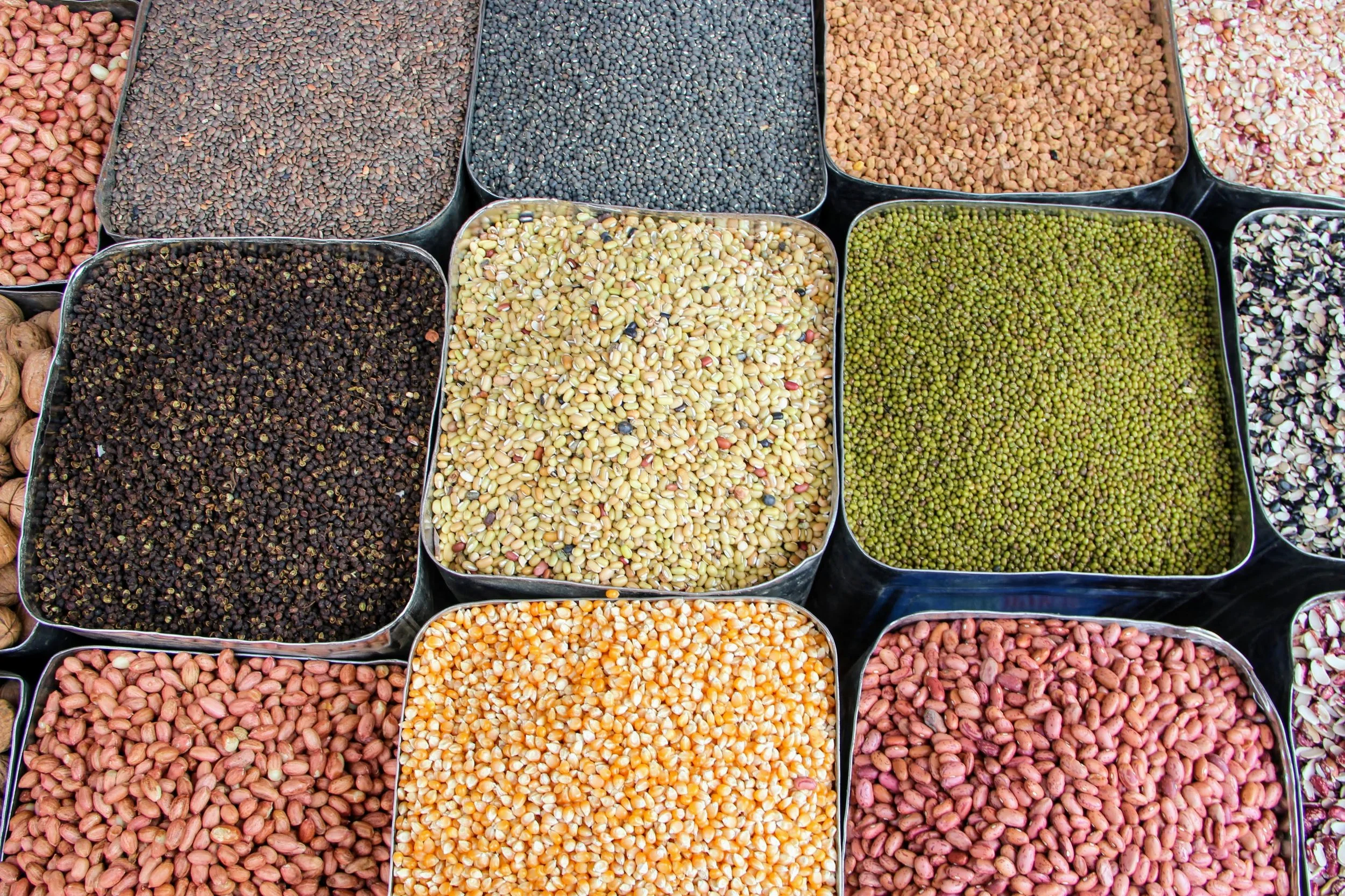
Credit: Yoav Farhi (Unsplash)
Legumes get an unfairly bad rap. I’m here to flip that narrative, though maybe not in the way you’d expect. Sure, they’re good for our health, our planet, and animals (opting for a black bean patty over a beef burger makes a difference). Yet, despite the solutions legumes offer, meat consumption has tripled over the past 50 years, and diet-related disease puts individuals at risk globally. The United Nations Food and Agriculture Organization (FAO) marked International Pulses Day on February 10th (pulses being the dry seeds of legumes, like lentils), but the celebration rarely makes it beyond a niche audience. It’s time to reconsider the critical importance of legumes—understanding the past to better shape our future.
This narrative isn’t just about healthy and sustainable food. As a researcher studying legume-based agroecosystems, I’m interested in how they shape ecological processes, agronomic systems, and biocultural perspectives on nutrition.
Humble Be(an)ginnings
The legume botanical family, Fabaceae, has been intertwined with humanity since before humans were human. The oldest legume fossil clocks in at about 70 million years, but the family probably goes back closer to 100 million. When the first definitive primates appeared around half a million years ago, they emerged alongside the explosion of flowering plants (angiosperms), which would eventually be domesticated as food crops. And still, long before humans intensively cultivated crops, our ancient hominin ancestors were already eating legumes.
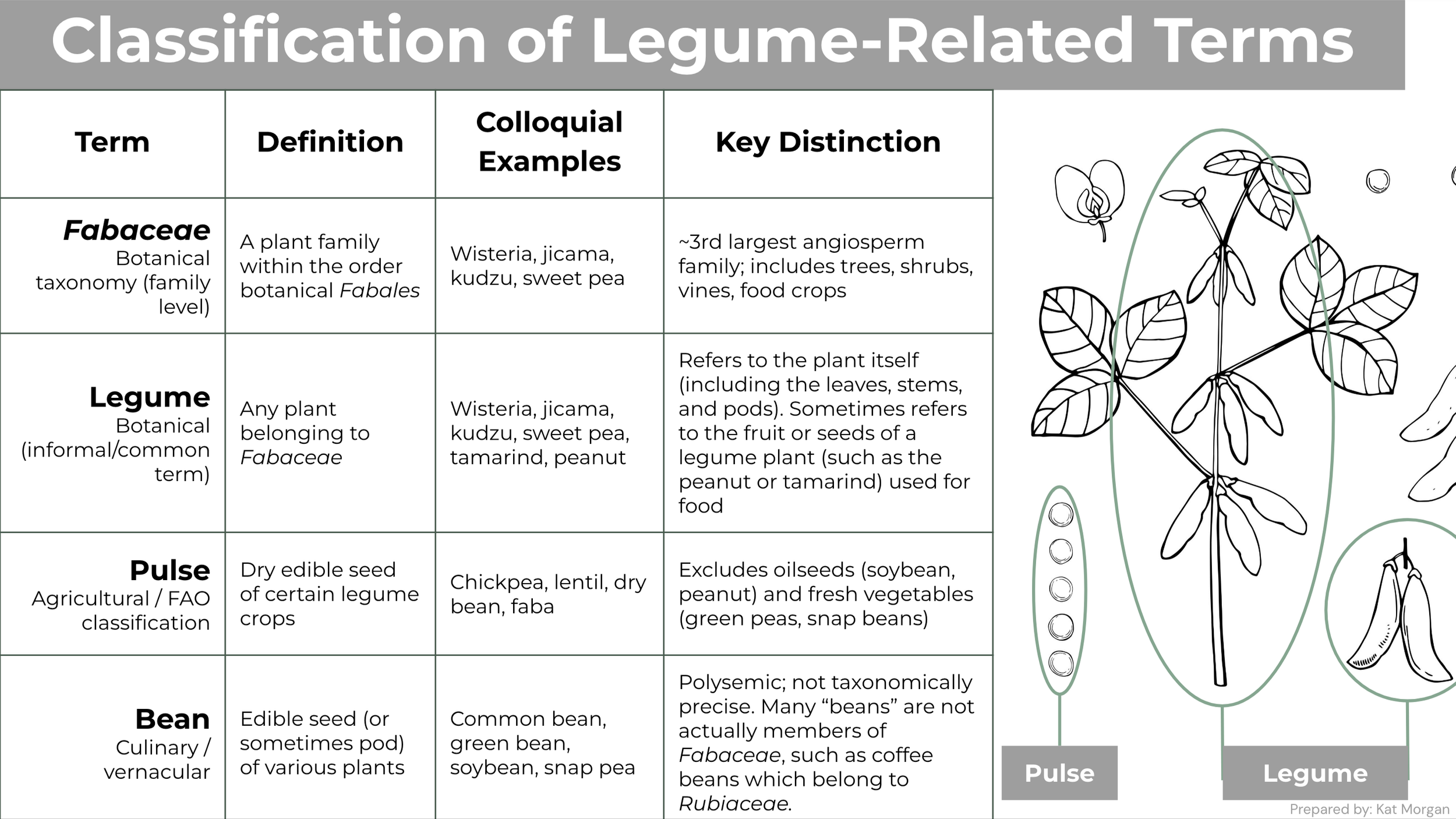
Source: Created by Kat Morgan Adapted from
Siddiq, M., & Uebersax, M. A. (2022). Dry Beans and Pulses Production, Processing, and Nutrition (2nd ed). John Wiley & Sons, Incorporated.
Harvard T.H. Chan School of Public Health. (n.d.). Legumes and pulses. The Nutrition Source. Retrieved February 25, 2026, from https://nutritionsource.hsph.harvard.edu/legumes-pulses/
Eckel, P. M. (n.d.). Legume — A grammatical dictionary of botanical Latin. Missouri Botanical Garden. https://www.mobot.org/mobot/latindict/keyDetail.aspx?keyWord=legume
Legume image: stock photo provided by Google
Humans began domesticating plants during the Neolithic period, over 10,000 years ago. Archaeological evidence even suggests faba beans (edible pulses and members of the Fabaceae family) may have been cultivated in the Fertile Crescent as early as 14,000 years ago—potentially before, or at least alongside, early wheat. If this timeline holds, it complicates the usual story that puts wheat, maize, and rice at the center of “civilization.”
What Makes Legumes Special
First, it’s no wonder our ancestors prioritized these plants. The archaeological record (for the time being) indicates not only early cultivation of legumes but also at least seven unique global domestication events. Legumes are high in fiber, slowly digestible starch, and essential minerals like iron, zinc, magnesium, calcium, and potassium. They are still crucial for improving diets and well-being for billions globally. They offer a low-cost, familiar protein. Eating more nutrient- and protein-rich legumes is linked to reduced risk of metabolic health issues, cardiovascular disease, and colorectal cancer.
Second, they may not be a shiny new innovation, but legumes are important players in maintaining nutrient cycles of healthy ecosystems. The Fabaceae (legume botanical family) are biologically unique; many cultivated legumes are self-pollinating and self-fertile. But it’s more than that—they help build and sustain soil, a living, non-renewable resource essential for life as we know it. Through specialized partnerships with soil bacteria, legumes turn atmospheric nitrogen (N₂)—useless to most plants—into forms the plant can use. This natural process is called biological nitrogen fixation, whereas synthetic fertilizer production industrializes and externalizes a nitrogen-fixing process that has long been mediated by beans and bacteria.
Nitrogen in Agroecosystems
This capacity for nitrogen fixation isn’t trivial. Nitrogen is an essential nutrient for plant growth and a fundamental component of amino acids, the building blocks of protein. And beans are protein-rich compared to their cereal counterparts (think corn, wheat, rice, amaranth, spelt). A plant that generates fertility and delivers protein-dense seeds would have been valuable to early farmers, and remains so in the 21st century.
Today, there are roughly 1.4 billion hectares of arable land worldwide actively used to grow crops. On average, farmers apply about 134 kilograms of synthetic fertilizer nutrients per hectare each year, which adds up to nearly 188 million metric tons (MMT) of industrial nutrients spread across croplands annually. Nitrogen alone is more than half (possibly as much as 115MMT) of what's applied to farm fields. According to the UN, up to 80% of synthetic nitrogen applied in agriculture is not taken up by crops and lost to the environment through nitrate leaching, runoff, and gaseous emissions.
Legumes and their microbial partners are estimated to fix millions of metric tons (MMT) of nitrogen annually, potentially in the range of 39-70 MMT or greater. Given that legumes and their microbial partners already make millions of metric tons of nitrogen each year, and much of the synthetic fertilizer is a major environmental pollutant, this raises a compelling question: how much fossil fuel–dependent nitrogen use could be reduced by shifting toward legume-based agroecosystems and away from cereal monocropping? (1)
While it’s easy to put legumes on a pedestal, beans and cereals aren’t rivals; their complementary nutritional profiles lend to a balanced amino acid pairing to deliver protein needs and satiety. Legumes provide lysine; cereals offer sulfur-containing amino acids and energy. Cultures have paired them for millennia (e.g., corn and beans, daal and rice). From an agricultural perspective, because cereal crops need a lot of nitrogen, they benefit from legumes’ biological nitrogen fixation. Today’s food systems, however, favor intensive global cereal production and have broken this biological-nutritional partnership.
The Pain: Where Did They Go?
Fossil-fuel–intensive agriculture, corporate consolidation, and the erosion of land-based knowledge have tragically narrowed the diversity of what we grow and eat—beans included. Today’s diets center on maize, wheat, and rice. Soy, while a legume, has been produced at scale where 70-75% ends up as feed for meat: chickens, pigs, cows, and farmed fish. Those with high-incomes reach for animal-based proteins, while broader inequalities determine who eats what, and why.
The structures of food production, distribution, and consumption at today’s intensified, industrial scales aren’t sustainable, and degrade ecosystems, generating significant greenhouse gas emissions. We churn out plenty of calories, but more people face malnutrition—either from lack of food or from diets high in calories and low in nutrients (ultra-processed foods are generally the culprit). Industrial agriculture prioritizes yield, uniformity, and shelf life over nutrition and biodiversity, where our current global food system accounts for about a third of global greenhouse gas emissions. A chunk comes from making and using synthetic nitrogen fertilizers—a fossil-fuel–hungry process that drives soil degradation, water pollution, and ecological upheaval.
Now layer climate change onto this system. Projections suggest that by 2050, nearly 150 million people could face increased protein deficiency as crop nutrient density declines. Unlike many cereal crops, legumes may be physiologically better positioned to respond to rising CO₂ because they can adjust nitrogen supply through symbiosis. Those with the least capacity to adapt, particularly in low- and middle-income countries, may bear the greatest burden. In light of these serious issues, legumes might just be place-based solutions that improve people's livelihoods and support climate adaptation and mitigation.
Reality: No Such Thing as a Quick Fix
Legumes aren’t a panacea (and beware of folks who suggest one food-system cure-all exists). But they’ve been steadfast collaborators, meeting and following us across ecological niches, cultural traditions, and political economies. Re-centering legumes isn’t nostalgia but rather a structural rethink for the future of food.
My hope with this mini treatise is to spark year-round enthusiasm for legumes—not just on the 10th of February. Maybe the question isn’t “Who wants seconds?” but why we stopped asking for beans in the first place.
(1) Note: the degree and extent to which legumes can directly reduce adverse impacts on global planetary systems and improve multi-species benefits from food system activities is complex and context dependent.
Learn more:
"Beans is How" is a global campaign and coalition of over 120 organizations aiming to double the consumption of beans, lentils, and pulses by 2028 to tackle climate, health, and cost-of-living challenges
Pan-Africa Bean Research Alliance (PABRA) is all about beans. They believe that beans can improve the food security, income, and health of smallholder farmers and urban dwellers across Africa.
Building on the success of the International Year of Pulses (IYP) in 2016 implemented by FAO and recognizing the potential of pulses to further achieve the 2030 Agenda for Sustainable Development, the United Nations General Assembly (UNGA) designated 10 February as World Pulses Day (WPD).
Kat Morgan, MPH, is a PhD student of Environmental Studies at New York University, focusing on food and land use systems. Trained in cultural anthropology and environmental health, she studies how legume-based agroecosystems shape ecological processes, agronomic systems, and biocultural perspectives on nutrition. Kat also hosts the award-winning food systems podcast Oh Crop!, where she interviews scientists, farmers, and changemakers for listeners curious about the future of food.
