The New Dietary Guidelines for Americans
or how to deceive the public, enrich the meat industry and fuel climate change.
Last month, the Trump administration released the Dietary Guidelines for Americans, a 90-page report (with 400 pages of appendices) outlining federal dietary guidance for the next five years. This publication carries significant weight, shaping food procurement decisions for hospitals, schools, and prisons nationwide. Robert F. Kennedy Jr., the United States Secretary of Health and Human Services and a key architect of the report, is clear: Americans should ‘eat real food’. And here’s how:
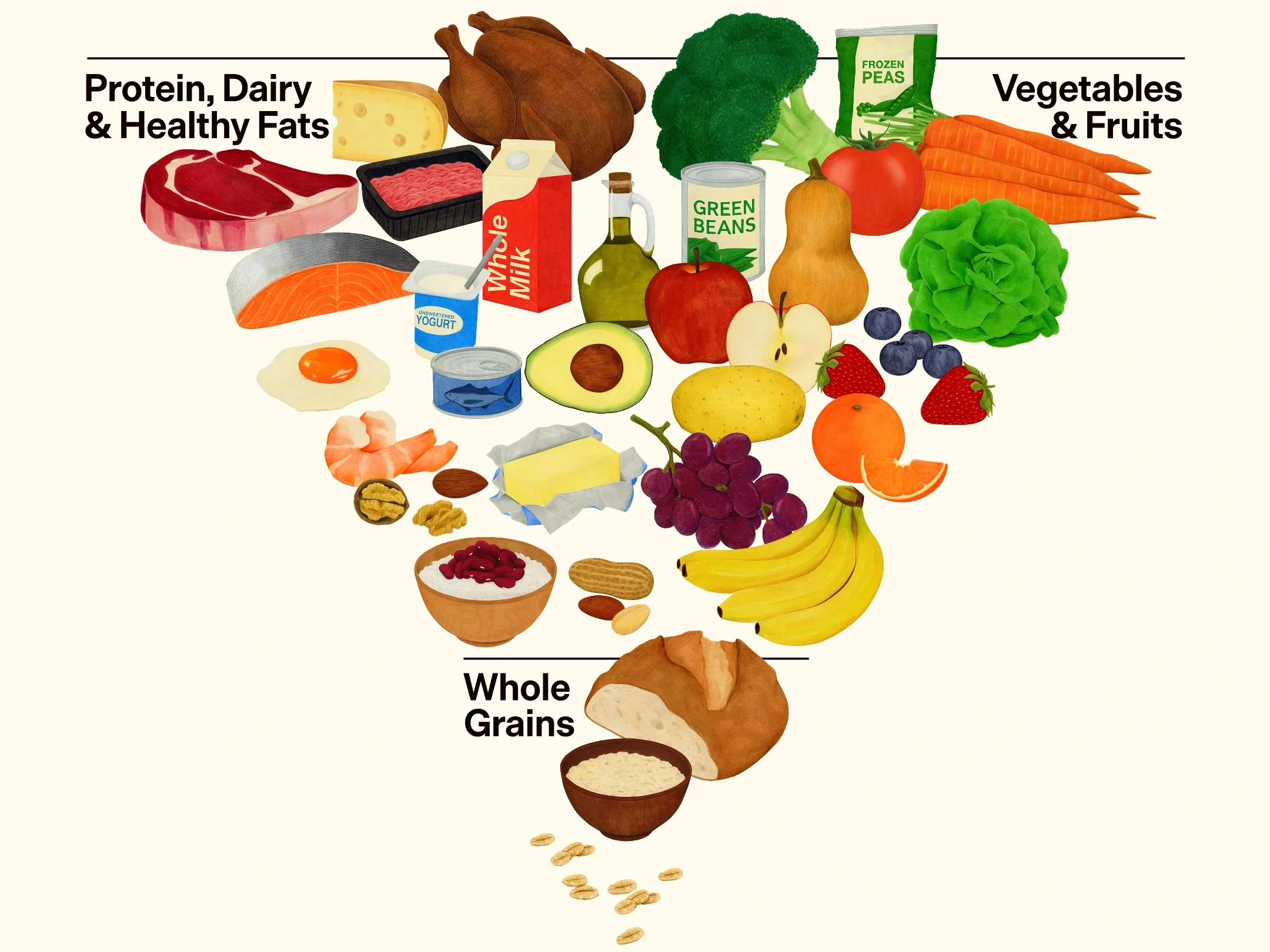
New Food Pyramid, from realfood.gov
The new food pyramid–placing animal protein, dairy, fruits, and vegetables at the top, and bread, oats, and rice at the bottom–marks a return to the pyramid model after years of using the “plate” system. The reintroduction of this model, along with the associated recommendations, has been largely criticized by health experts.
What the report gets right
Not everything in the report should be dismissed. Several recommendations are sensible and important, and are part of a wider scheme to address the health crisis in the United States. The figures speak for themselves: about 40% of Americans suffer from obesity, and 75% live with at least one chronic disease–conditions driven in large part by the widespread availability and consumption of ultra-processed foods (HPF).
The report is structured around what it calls “a simple principle: minimally processed, naturally nutrient-dense foods are the reference point for dietary guidance” (p. 1), noting that “consumption of HPF is consistently associated with adverse health outcomes” (p. 191 of appendices). These guidelines reiterate well-established recommendations from prior editions and the broader scientific literature: eating simple foods, more fruits and vegetables, favoring whole grains over refined grains, and limiting added sugars.
The report even offers practical guidance for consumers on how to identify highly processed products. For example, it explains how to recognize sources of added sugars (e.g. ingredients containing the words “sugar” or “syrup,” or ending in “-ose”), how to distinguish true whole-grain cereals from highly processed alternatives (p. 19), and how to tell the difference between minimally processed and processed yogurt (p. 34).
What is contested
However, several recommendations contradict the scientific consensus and remain highly controversial. One striking example concerns meat consumption. While it is well established that intake of both processed and unprocessed red meat should be limited, the new pyramid places a ribeye steak, ground beef and other animal proteins at the top. This shift is justified by the claim that “observational associations linking meat intake with chronic disease risk are inconsistent and may be largely driven by processed-meat subtypes” (p. 38). This framing selectively downplays a substantial body of epidemiological evidence linking red and processed meat consumption to adverse health outcomes, while elevating uncertainty in ways that favor animal-based foods.
By foregrounding sensible advice (as mentioned earlier), the guidelines lend credibility to broader, misleading claims, further confusing the public around nutrition-related information and ultimately undermining public health. The polished design and user-friendly presentation of the recommendations’ website also play a role, in our view, in shaping how this information is perceived by consumers.
Concerns are further compounded by potential conflicts of interest. Scientific reviews of this scope are expected to adhere to strict ethical standards, including the avoidance of conflicts of interest. Yet several nutrition experts commissioned by the administration have documented ties to the meat and dairy industries. For example:
J. Thomas Brenna has had consulting roles with the National Cattlemen's Beef Association and Texas Beef Council as well as Nutricia, a subsidiary of Danone.
Donald Layman has financial ties with National Cattlemen’s Beef Association and National Dairy Council
Heather Leidy received funding from the National Cattlemen’s Beef Association, the National Pork Board and General Mills Bell Institute of Health and Nutrition.
As noted earlier, these guidelines extend far beyond individual dietary choices. They directly shape food menus in schools, hospitals, and other public institutions, channeling billions of dollars toward large agricultural industries with which some of these experts are affiliated.
The pyramid is also misleading in its representation of recommended portion sizes. According to the guidelines, achieving a 2,400-calorie daily intake would require:
3.5-4.5 portions of protein
3.5 portions of dairy
2 portions of vegetables
2.5 of fruits
2.75-5.25 portions of whole grains
5 portions of healthy fats
Under this framework, fruits and vegetables account for only about one quarter of total caloric intake, despite longstanding recommendations that these foods should comprise roughly half of total portions.
Additionally, these recommendations assume widespread access to fresh, diverse foods–an assumption that does not hold for many Americans. “Food deserts”, defined as areas with limited access to affordable, nutritious food, remain a reality for millions of households and are disproportionately concentrated in low-income, non-white communities. Difficulty accessing food is further exacerbated by inflation. By December 2025, overall inflation reached 2.7% on a 12-month basis, while prices for major food categories rose by 3.1% over the same period. Finally, the guidelines are deeply rooted in European ancestry and are poorly adapted to populations with high rates of lactose intolerance, including Asian, Hispanic, Black and Indigenous communities, which represented about 40% of the total US population in 2024.
Why it matters for the climate
These new guidelines effectively incentivize the production of meat and dairy products, which are among the most greenhouse gas–intensive foods. Increased meat and dairy production drives deforestation, intensifies water use, and raises greenhouse gas emissions, thereby exacerbating climate change. On this point, the scientific evidence is clear.
As acclaimed climate journalist Emily Atkin puts it in her most recent article: “You cannot build a healthy society on top of an unhealthy biosphere. The climate, water, soil, and land that produce our food are as important to our health as the food itself. Without them, all our talk of “healthy eating” becomes a kind of denial—pretending we can thrive while the systems that keep us alive break down.”
Dietary change represents a powerful mitigation strategy: shifting toward plant-rich diets can substantially reduce emissions while also delivering well-documented health benefits. But by incentivizing greater meat consumption, the guidelines shape demand in ways that financially benefit large agricultural producers. Increased revenues can, in turn, enhance these industries’ capacity to exert political influence through, for example, lobbying, ultimately making impactful mitigation policies harder to implement.
While the United States is moving away from decades of scientific consensus, other places are moving in the right direction. Amsterdam, for instance, will ban meat advertising in public spaces starting on 1 May this year. Just 6 days ago, École Polytechnique de Montréal, an engineering university in Montreal, Canada, announced that it was removing beef options from its cafeteria menus. Now, more places need to follow their lead.
