Rice and Easy
Why and how conventional rice farming practices need to change?
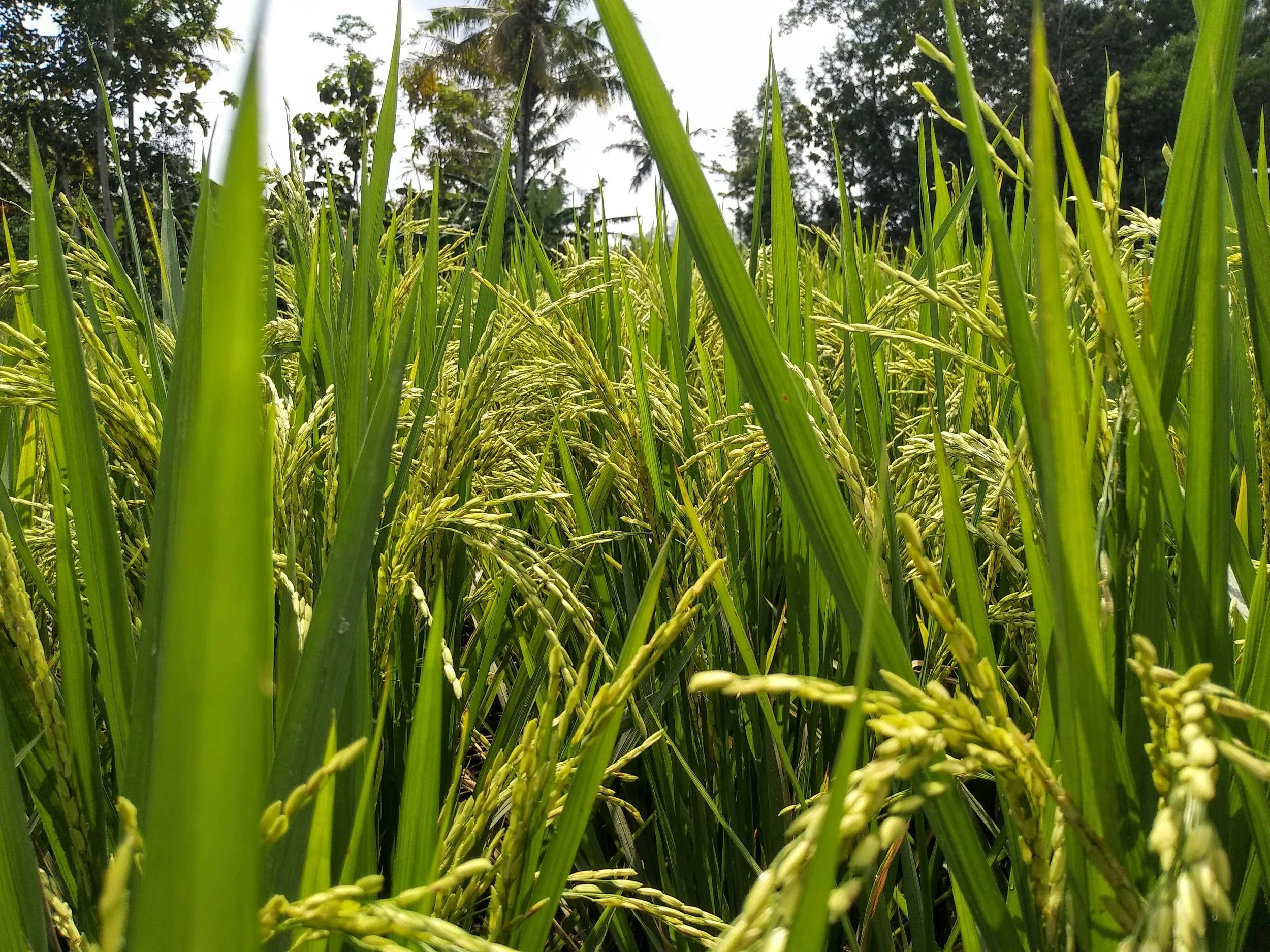
Credit: Andhika Y. Wiguna
Origin of rice and domestication
While its exact origin is still debated, rice likely originated in one of three places: the middle and lower Yangtze River valley in China, the Mekong River valley in Southeast Asia, or the middle Ganges River valley in northern India. Like many other staple crops, rice was first domesticated around 10,000 years ago. Rice grains dating back to 6,500 and 6,000-7,000 BC were found in the Yangtze River basin and in Jiahu, north of Henan, China. It’s also possible that rice was domesticated simultaneously in China, India and Indonesia, leading to the development of three groups of rice: japonica, indica and javanica. Today, between 40,000 to 120,000 varieties of rice have been identified.
Global Rice Production
Rice, in its many different forms and varieties, is a global food staple that features heavily on our plates. Not only does it provide more than a fifth of the calories consumed by people worldwide – making it the leading cereal crop in terms of meeting human food needs – but it is also the third most harvested crop after wheat and maize. According to the United Nations Food and Agriculture Organization, a record high of 820 million tonnes of rice were produced in 2024.
While rice is grown on six out of the seven continents (sorry, Antarctica!), production is largely concentrated within Asia. India and China are the world’s leading producers, responsible for nearly 52% of the global rice supply. This comes as no surprise, as both countries are also the world’s leading consumers of rice. Current projections indicate that global rice demand will continue to grow over the next 25 years, driven by population growth in Asia and Africa and by shifts in consumer preferences linked to income growth and urbanization.
As is the case with many staple crops, there are concerns about how increased rice demand will lead to negative environmental impacts. Rice farming is mainly based on intensive cultivation techniques that involve the continuous flooding of paddy fields. Farmers mostly irrigate to suppress the growth of weeds and some plant pests, but also because many believe rice is an aquatic plant that benefits from flooding. A negative consequence of continuous flooding is methanogenesis, a biological process that produces methane through the anaerobic decomposition of organic matter. The release of methane is particularly harmful because it is a potent greenhouse gas with a high global warming potential over short timescales (80 times greater than carbon dioxide over 20 years) and a moderate global warming potential over longer timescales (27 times greater than carbon dioxide over 100 years).
Climate pressures
Although it’s still unclear when flooded rice systems were first adopted, they are now the dominant rice production system: today, about 75% of the world’s rice production comes from irrigated systems, primarily flooded paddies. But in the face of a changing climate, these systems are increasingly exposed to new pressures and hazards.
For instance, a recent study identified temperature thresholds under which rice can be optimally cultivated – approximately 28°C for mean annual temperature, and 33°C for warm season maximum temperatures. Results from climate projections suggest that these limits will likely be surpassed by the end of the century in areas where rice is densely cultivated, which could have significant consequences on food security.
Moreover, since flooded rice production is highly water-intensive, it is particularly vulnerable to changes in hydrological conditions. In a warming world, extreme events such as droughts and floods can directly reduce yields, while reductions in rainfall can limit water availability and exacerbate groundwater depletion. In coastal regions, salt water intrusion is another threat to water availability that can affect both crop production and farmers’ livelihood.
Alternatives to Conventional Rice Production
As methane emissions increase and climate change-induced threats become more prevalent, it’s clear that alternatives to conventional rice production are much needed to sustain global demand and reduce environmental impact. Fortunately for us, some of these alternatives already exist and are being practiced by farmers across the world. Most notably, The System of Rice Intensification (SRI).
Developed in Madagascar during the 1980s by Father Henri de Laulanié, SRI deviates from conventional methods by focusing on the quality of plant growth rather than the quantity of inputs. The method was born out of necessity as Father de Laulanié made it his mission to help Malagasy farmers improve their productivity without being dependent on costly external inputs. Unlike traditional flooded cultivation, which creates anaerobic conditions that trigger significant methane release, SRI utilizes Alternative Wetting and Drying (AWD) techniques to keep soils aerobic. The practice of AWD involves allowing the surface water of rice fields to disappear, typically for between 1 and 10 days, before the field is irrigated again. This not only reduces the amount of water that is required for rice production but also prevents methanogenesis from occurring in the soil, thereby reducing the amount of methane gas that is emitted into the atmosphere. In fact, SRI has been found to reduce water consumption by up to 50% and methane emissions by up to 40%.
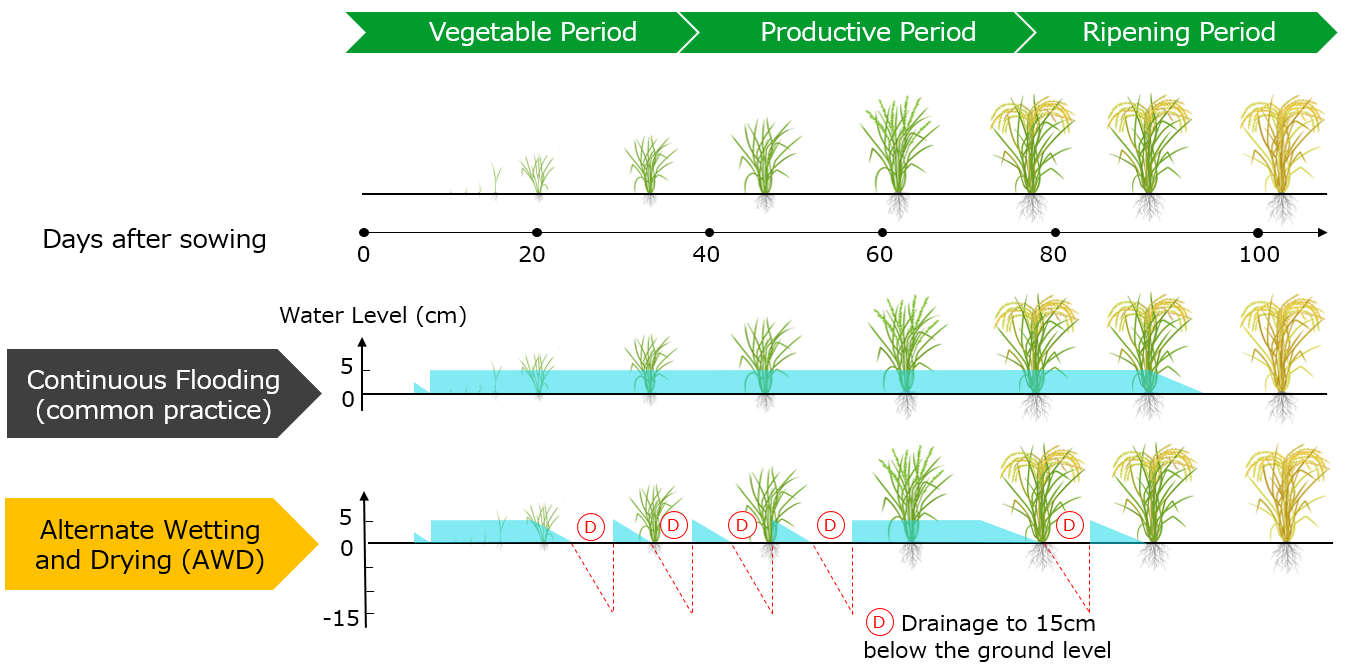
Credits: Kubota
By shifting the focus from external chemical inputs to the enhancement of the plant's own root system and soil health, SRI delivers significant benefits that extend beyond positive environmental impacts. On the production side, farmers have frequently reported yield increases despite using fewer seeds and less water. In Cambodia, farmers utilizing SRI techniques have averaged 3.2 to 3.9 metric tons of paddy rice per hectare, which represents 25 to 50% more than the national average of 2.6 metric tons.
Producing more with less has also led to increased farmer income and profitability. A report from Cuba on SRI rice production showed a yield increase of only 15%, but a net income increase of 70%. Income rose because: (a) seed costs were cut in half, (b) fertilizer use was reduced by 89%, (c) 40% less water was used, a significant saving because irrigation water had to be accessed by diesel pumps, and (d) the labor needed for transplanting was reduced from 16 to 5 people.
Future Outlook
Despite its proven potential, the global acceptance of SRI by farmers has not caught on as quickly as one might expect. The counterintuitiveness of getting more yield from less has led to some hesitation and speculation. Farmers tend to be rather conservative in their decision-making and take some convincing before transitioning to a new system. Because SRI is a knowledge-intensive rather than an input-intensive strategy, its success depends on robust extension services and farmer-to-farmer training networks that require consistent public and private funding.
Current global agricultural subsidies often favor conventional chemical-heavy models, creating an uneven playing field that discourages smallholders from transitioning to aerobic soil management. Therefore, it is crucial that moving forward, governments divert investment toward SRI research, infrastructure, and policy integration, so that we can stop seeing rice production as a climate-change problem and start seeing it as a solution.
