Is a “super” El Niño really on its way?
Answering some key questions about this potentially historic climate phenomenon.
Credit: Elena Mozhvilo via Unsplash
If you’ve read the news recently, you’ve probably heard about how “the most powerful El Niño” is on its way this year. But is that really the case?
What is El Niño?
El Niño is a climate phenomenon characterized by unusually warm ocean temperatures in the central and eastern equatorial Pacific Ocean, extending toward the coast of South America. It is the warm phase of El Niño-Southern Oscillation (ENSO), a natural climate cycle (that also includes a cold phase known as La Niña) that occurs every 2 to 7 years, during which El Niño usually lasts 9 to 12 months.
Why are there fluctuations between El Niño and La Niña?
Under “normal” conditions, the tradewinds push warm water from the eastern equatorial Pacific toward the west, where it piles up near Indonesia and Australia. In the eastern Pacific, this westward movement allows cold, deep water to rise to the surface through a process called “upwelling”, creating a “cold tongue” of water along the equator off South America.
During an El Niño event, the tradewinds are weaker. Less warm water is being pushed westward, and the normal process of upwelling doesn’t occur. The warm water that is usually off the coasts of Indonesia and Australia moves eastward, allowing sea surface temperatures to rise above normal in the central and eastern Pacific. The opposite conditions – stronger trade winds and cooler ocean temperatures in the central and eastern Pacific – define La Niña.
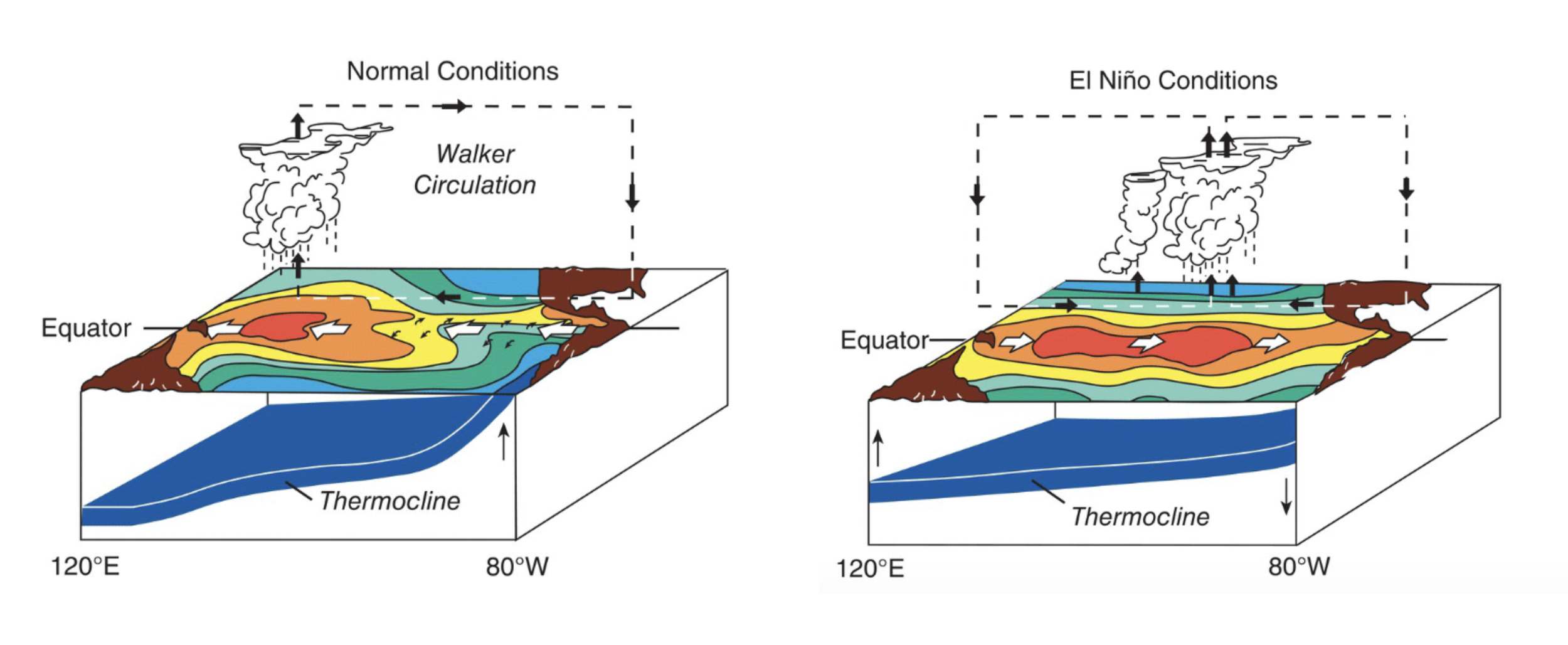
Credit: adapted from McPhaden et al, 2020
Can we forecast ENSO?
Yes! The first ENSO forecast dates back to the 1970s, and by the 1990s routine forecasts were issued using coupled climate models (models that combine multiple elements of the earth systems; e.g. ocean and atmosphere). Scientists can make ENSO predictions several months in advance, although predictions are less accurate the further away they look. Forecast skill (or accuracy) also drops in the spring* because of the “spring predictability barrier”, making ENSO conditions harder to predict at that time of year.
*of the northern hemisphere
Are we heading towards a “super” El Niño?
As of two weeks ago, the International Research Institute (IRI) announced that we were transitioning into El Niño conditions, as a “sharp warming [in the equatorial pacific] strongly indicates that the currently near neutral seasonal averages will rise substantially in the coming months, marking a clear shift from ENSO neutral to El Niño conditions”. While there is higher confidence that an El Niño event will form, we can’t predict the strength/intensity of that event. In other words, we don’t know if this will be a “super” El Niño just yet.
How does it impact food production, and climate more broadly?
ENSO creates fluctuations from normal temperatures, which influences the atmosphere and ultimately impacts weather patterns across the world. During an El Niño event, some regions can experience increased droughts, while others can face climate extremes such as heavier rainfall, storms and flooding- which can pose significant risk on crop yields and food security globally. El Niño tends to have a warming effect on the global climate as well.
In the United States, inconsistent weather patterns throughout the start of 2026 have already led to significant crop damage. In the winter-to-spring transition, temperatures fluctuated from 70 to 80 degrees Fahrenheit on some days to 10 to 20 degrees on other days. These dramatic shifts have caused major damage to peach production in New Jersey, wheat production in the Midwest, and strawberry production in South Carolina. But the United States is not alone in experiencing weather-induced crop damage this year, as the most recent European heatwave also wreaked havoc on EU agricultural production. This is all to say that if a historic El Niño event does occur, food systems will be impacted in one way or another.
Fun fact: where does the name El Niño come from?
El Niño means "little boy" in Spanish. The term was coined by South American fishermen in the 1600s after they observed unusually warm coastal ocean currents around Christmas, which led to a decrease in fish stock. They called it "El Niño de Navidad," or "Christmas Child."
