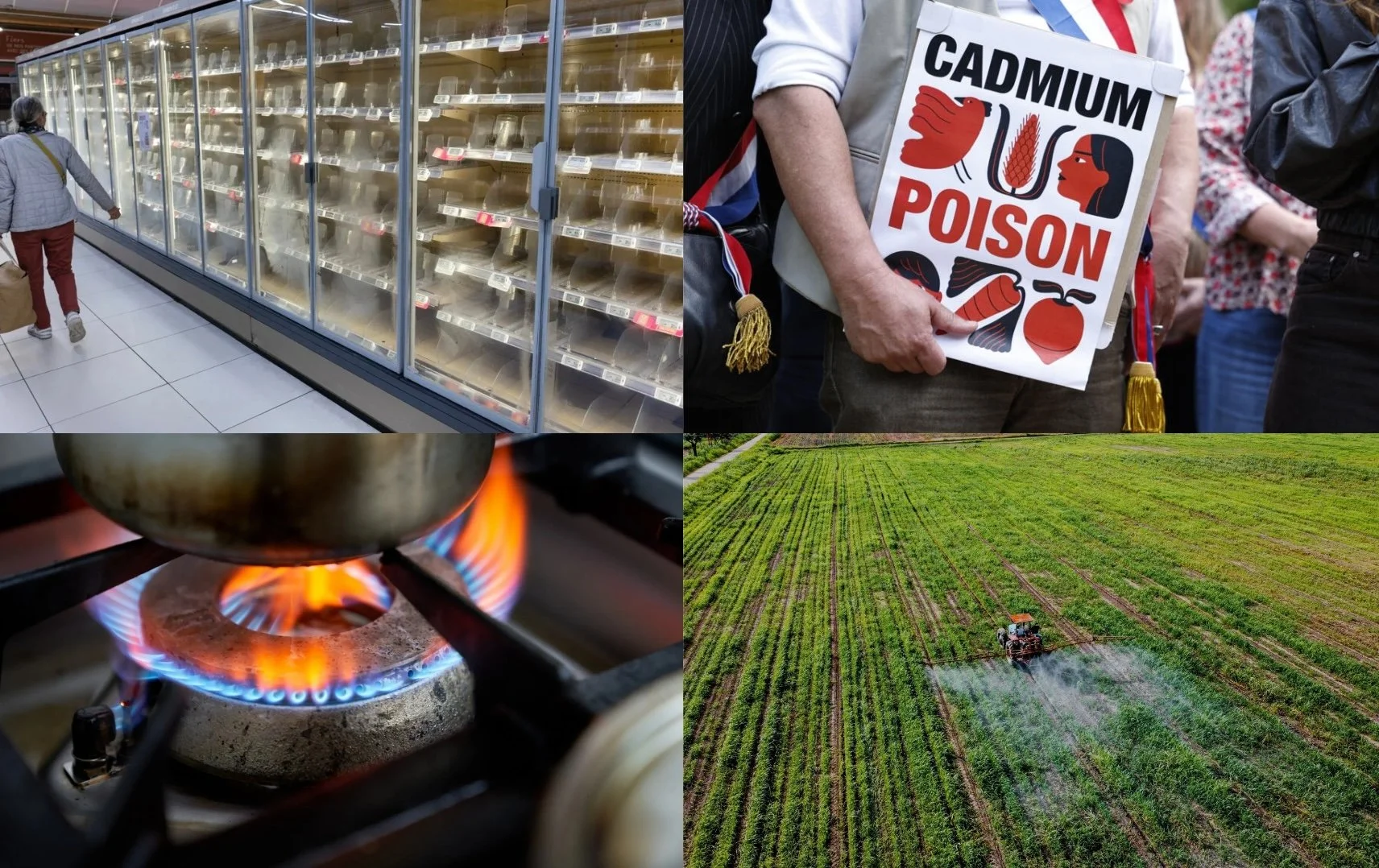
Photo Credit: Top left: Fred Tanneau, Getty Images; Top right: Simon Wohlfahrt, AFP; Bottom left: Javier Zayas Photography, CNET; Bottom right: Fuka Jaz, Pexels.
Food-related news
The Cadmium Gate
While “Cadmium” might not be a hot topic in the US media, it has sparked much debate in France. Earlier this year, a study conducted by the French Agency for Food, Environmental and Occupational Health & Safety (ANSES) revealed that the French population was overexposed to cadmium – a naturally occurring heavy metal found in soil. In June, the French National Assembly passed a bill aimed at “reducing health risks associated with cadmium contamination in food” by lowering the permitted levels of cadmium in phosphate fertilizers. However, this bill may have limited impact because, although fertilizers are the main source of cadmium input, these inputs are extremely low compared to the amounts already present in the soil.
READ MORE HERE
The Harmful Impact of Gas Stoves on Restaurant Chefs’ Health
For many restaurant chefs, the experience of cooking in commercial kitchens is an uncomfortable one, but not for the reasons you may think. While juggling multiple orders at once is certainly stressful, chefs are also having to contend with dangerous amounts of air pollution and heat emitted by gas-fired stoves. In a recent study, researchers found that 70% of kitchens using gas-fired stoves had Nitrogen Dioxide concentrations that surpassed what’s considered safe by the Environmental Protection Agency and the World Health Organization. Despite the use of commercial-grade ventilation systems, the difference in conditions between kitchens using fossil-fueled equipment versus all-electric equipment is quite significant. Maybe it’s time for a clean-cooking transition?
READ MORE HERE
Hackers Are Turning Up the Heat
This past month in France, hackers initiated a cyberattack on grocery store refrigerators and freezers, affecting around 500-700 stores and leading to major amounts of food waste/spoilage. In some instances, the attack caused fridges to heat up to as much as 122 degrees Fahrenheit (50 degrees Celsius). As more critical infrastructure becomes connected to the internet, cyberattacks like this one have the potential to cause real-world damage, especially when it comes to disrupting food supplies.
READ MORE HERE
The Toxic Harvest
A recent study reveals that nearly half of the world’s farmers–over 400 million people–suffer from acute pesticide poisoning every year. Many farmers are often legally required to use specific chemical inputs and rely heavily on advice from agrochemical representatives due to a lack of independent agroecological guidance. The crisis hits hardest in regions like South Asia, Southeast Asia, and East Africa, where farmworkers, women, and children frequently face serious health impacts with little access to healthcare or protective gear. To break this cycle of chemical dependency, health advocates are urging global leaders to phase out highly dangerous products and support farmers in transitioning to safer, pesticide-free methods.
READ MORE HERE
Non food-related news
The Living Planet Index, a misinterpreted metric
You may have seen headlines stating that “wildlife populations have declined by 70% since 1970”. These claims are based on the Living Planet Index report, which is published every two years by the WWF and the Zoological Institute of London (ZSL). The report uses the Living Planet Index – which measures the average decline in monitored wildlife populations – as an indicator of the state of the world’s biodiversity. While this figure comes from a reliable source, it is often misinterpreted: it does not mean that 70% of wild animals have disappeared. Hannah Ritchie, deputy editor of Our World in Data, explains why claims from the LPI are often misunderstood and what they actually mean for biodiversity.
READ MORE HERE.
Where is El Niño heading?
In a previous article, we answered some key questions about El Niño. Since then, the climate phenomenon has continued to strengthen. As of September 21, the daily anomaly in the Niño 3.4 region – a zone of the central equatorial pacific ocean used by scientists to monitor El Niño and measure how much warmer sea surface temperatures are than the average – reached +3.11°C*, surpassing the daily record of +3.08°C set in November 2015. Whether this current event is on track to break new records, or become the strongest El Niño of all time, remains to be seen.
READ MORE HERE.
*Note that the monthly anomaly for Niño 3.4 was +2.8°C for September 2026.
